
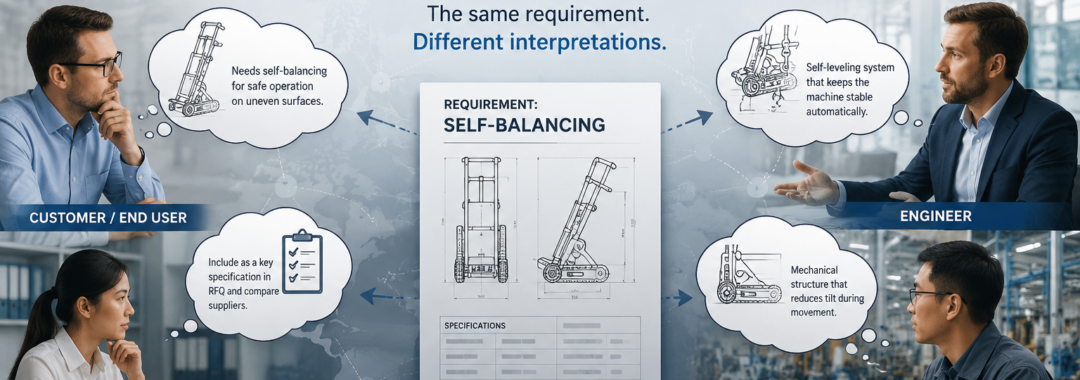
Finding suppliers, comparing prices and managing logistics are all important parts of cross-border industrial procurement.
However, before any of these activities can be done effectively, there is a more fundamental challenge:
Do all parties truly understand the same requirement?
Why is this one of the biggest challenges in cross-border industrial procurement?
Because this sourcing risk is easy to overlook. In many cases, everyone assumes that their understanding of a requirement is the same as everyone else’s.
However, this assumption can easily lead to misunderstandings.
To understand why, let’s take a closer look at three key aspects.
- About Technical Terminology
Language is an obvious challenge in cross-border procurement. However, even when everyone communicates in the same language, misunderstandings can still occur.
Technical terms may have different meanings depending on the industry, region or company.
A particular term may describe a function, a technology, an expected performance result or simply a marketing feature.
This is why understanding a technical term is not always the same as understanding the actual requirement.
The more important question is not simply:
“What do you call this feature?”
but:
“What exactly do you expect the equipment to do?”
In industrial equipment sourcing, understanding the intended application and expected result is often more important than translating the terminology itself.
2. About Different Professional Perspectives
Another challenge is that the same requirement is often interpreted by people with different professional perspectives.
A customer may focus on the desired result.
A purchasing professional may focus on specifications, price and supplier capability.
A salesperson may focus on identifying an existing product that appears to meet the requirement.
An engineer may focus on technical principles, feasibility and performance limitations.
None of these perspectives is wrong.
However, each person may interpret the same requirement differently.
As the requirement moves through the procurement process, small differences in understanding can gradually develop.
This does not necessarily mean that anyone is communicating incorrectly.
It simply reflects the fact that different people approach the same problem from different professional perspectives.
3. About Defining Technical Requirements
Customers often know the problem they want to solve and the result they expect.
However, the exact technical requirement may still need further clarification.
This is where industrial sourcing becomes more than simply finding suppliers.
Market research, technical discussions and communication with manufacturers can sometimes reveal information that was not available at the beginning of the project.
A feature that initially appears clearly defined may turn out to have different technical interpretations or limitations in real-world applications.
As new information becomes available, it may be necessary to return to the original requirement and ask:
Is this really what the customer needs, or is it simply the solution we initially believed was required?
For this reason, understanding requirements should not always be treated as a one-time step before supplier selection begins.
In complex industrial procurement, it is often an ongoing process.
In summary, the Biggest Sourcing Risk Is When Everyone Thinks the Requirement Is Clear
Misunderstandings are relatively easy to identify when someone says:
“I don’t understand.”
The greater risk occurs when nobody says it.
Everyone believes the requirement is clear.
Everyone believes they understand the same thing.
And the procurement process moves forward.
The problem may only become visible later — when the supplier delivers a technically different solution, when the equipment does not perform as expected, or when an important feature is interpreted differently from what the customer originally intended.
By that stage, solving the problem can be expensive and time-consuming.
Understanding Technical Requirements Is Part of Risk Management
Successful cross-border industrial procurement is not simply about translating requirements from one language into another.
It is about reducing the gap between:
- What the customer means
- What the sourcing team understands
- What the engineer interprets
- What the supplier believes is required
This requires careful questioning, technical understanding and sometimes a willingness to challenge the assumption that the requirement is already clear.
Because in cross-border industrial procurement, the biggest communication risk is not always a misunderstanding that can be seen.
Sometimes, it is the misunderstanding that nobody realizes exists.